Every day, 77-year-old Diosdado Valdez walks along a ditch on the side of a highway west of Havana, using a knife to cut long grasses that he puts in a burlap sack to feed his three goats.
Valdez said he has been in Cuba all his years, cutting sugarcane and working in the fields. He said that this moment in the history of his country worries him.
“We don’t have a future if we don’t get help with oil,” said Valdez.
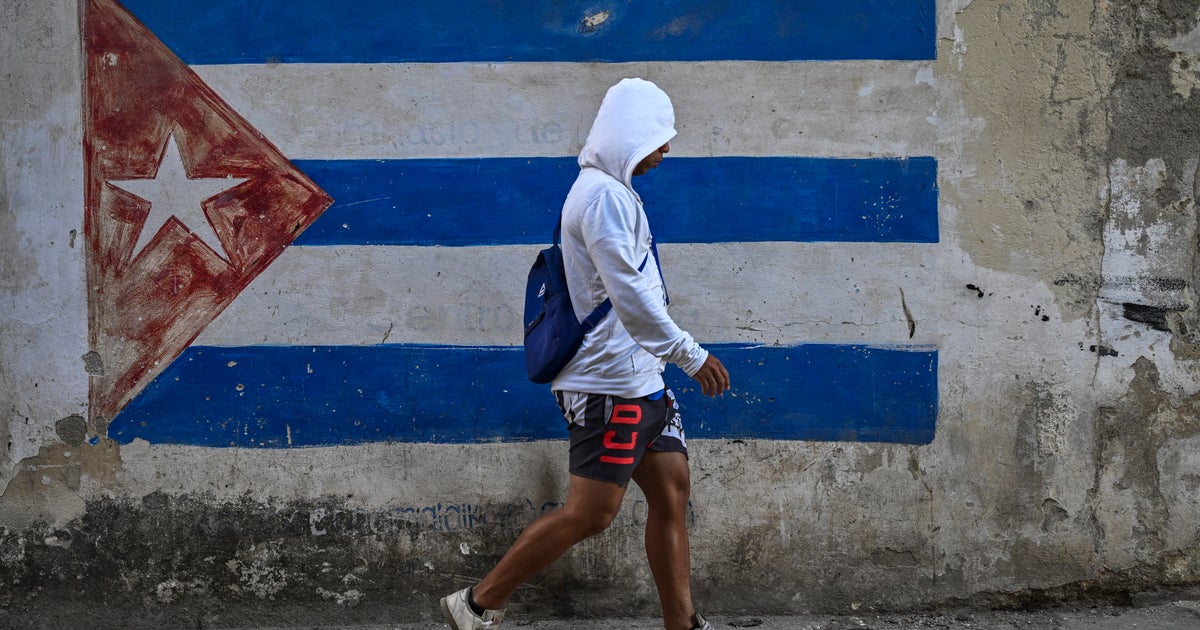
The US oil embargo on Cuba is now in its third month, creating an energy crisis that affects almost every aspect of daily life in a country that already suffers from an aging and crumbling infrastructure.
On Sunday, the New York Times reported that the US Coast Guard would allow a Russian ship full of crude oil to reach Cuba, bringing some aid.
Tracking data shows that the oil tanker, carrying an estimated 730,000 barrels of oil, had just arrived in the eastern part of the island on Sunday night and was due to arrive in the city of Matanzas on Tuesday.
Cuban media reporters also reported on the boat’s arrival, although Cuban officials did not immediately respond to a request for comment.
Amid the growing difficulties that plague daily life, some Cubans still believe that there is hope for a better future on the other side of this pivotal moment in the country’s history.
Cuba experienced a two-hour power outage over six days in mid-March, with prices for basic foods such as cooking oil, chicken and vegetables rising almost beyond the reach of most people.
The US has created a small exemption allowing private businesses to import fuel, amounting to about 30,000 barrels so far this year, according to Reuters.
But that accounts for only a fraction of demand in a country where the Communist government controls transportation, public works and health care, as well as food imports and much of the tourism industry, which has almost completely collapsed.
“You need to change the people in power. You need to change the system that runs the country, and you need to change the economic model that is being followed,” said US Secretary of State Marco Rubio on Friday after the G7 meeting in France.
“It is the only way forward if Cuba wants a better future.”
Former Cuban president Raúl Castro is leading the emerging negotiations with the administration of US President Donald Trump, the current President of Cuba. Miguel Díaz-Canel revealed in a recent interview shared by the state media.
Energy depletion and its debilitating effects have added another layer of hardship to a large portion of the population already living below the poverty line.
Frustration has sparked occasional protests. A Communist Party building was set on fire in the town of Morón, about 450 kilometers east of Havana, as well. the cacerolazos – pots and pans banging – exploded at night during a power outage.
Still, there is fear over many citizens, who worry that speaking publicly about the hardships they face could get them into trouble with the government.
CBC News spoke to many residents in Havana and Bauta, a city 40 kilometers west of the capital, where people filled the night with the sound of cacerolazos.
Many described the exhaustion of planning their lives around unexpected power outages – jumping out of bed at 3am to start cooking when the power suddenly came back on.
At the same time, many said they were worried that speaking freely about their daily problems could be interpreted as political criticism of the government and risk-taking.
“The situation is tense in this country,” said Ivette Arencibia, a volunteer at the Catholic church in Bauta.
Arencibia said it is difficult for many people in Cuba to speak.
“We are a country that has been living under a socialist regime for 60 years, this is one of the things that the Cuban people have. It is a little difficult to enter those bodies because you are entering an area of conflict,” he said.

Manuel Perez, 80, was a teenager during the Cuban Revolution. He later helped to reshape the country, becoming a teacher of reading and writing. He also lived in the Soviet Union studying engineering before returning to Cuba.
He said Cubans should not be afraid to express their feelings about the difficulties they are facing.
“These are the real difficulties we have today – the food shortage, the fuel problem, the problem of power outages … the neglect in various sectors, everything is there,” said Perez.
He said the system governing the country must improve.
“The change must be a positive change in the present time we live in. 60 years ago is not the same as 60 years later… There are things that must change,” he said.
Perez said he sees hope at hand.
“In the depths of darkness, in the depths of the same cave, there is light, even if it is a little far away,” he said.

Journalist and scholar Julio Aleaga, who is associated with the opposition parties in the country, has felt the punch of the Cuban government for crossing its lines.
Aleaga said that the police once caught him and beat him when he left his house in Havana at 8 a.m. They pushed him into the back of a cruiser and took him about 50 kilometers to the police station in La Lisa area, west of the capital, he said.
He was kept in solitary confinement until four o’clock in the afternoon, when a senior security officer came.
“He told me that I want to meet you… To him, wanting to meet meant that he is the boss and that he can beat me and that he can do whatever he wants with my life,” he said.
Aleaga wrote a novel called Maleconazo after an anti-government demonstration erupted in August 1994 along Havana’s famous sea wall, the Malecón. The book, published in 2022 and banned in Cuba, was set during the Special Period of the 1990s, after the collapse of the Soviet Union plunged the island nation into a deep economic crisis.
“It was a very difficult time, much more difficult than now,” Aleaga said.
Unlike today, when tight fuel rationing and the black market keep a limited number of cars running, there were no cars on the roads during the Special Period, he said.
“There was no electricity for anyone, not even government ministers or officials, not even tourists,” he said.
The country also faced the problem of food shortages which led to widespread vitamin deficiency and caused about 50,000 people to lose their sight due to a disease called optic neuropathy, said Aleaga.
He said that energy was estimated at that time in eight-hour periods – eight hours on, eight hours off.
“Today you don’t know when the electricity will be there and you don’t know when it will be cut off, you don’t know when the system will fail,” he said.
“That kind of uncertainty also makes this time different.”
Aleaga said the “irritating and disruptive spirit of the United States government” is another factor that adds to that uncertainty.

However, Aleaga does not seek US pressure to use the oil embargo to force the fall of the Cuban government.
“It could lead to a lot worse,” he said.
Aleaga said Cuba needs to follow the path of truth and reconciliation, similar to the one South Africa followed after the end of apartheid.
“I believe that is the direction we should go – through forgiveness, reconciliation, not a complete cleaning of the slate and a complete reset, but through a process of temporary justice,” he said.